
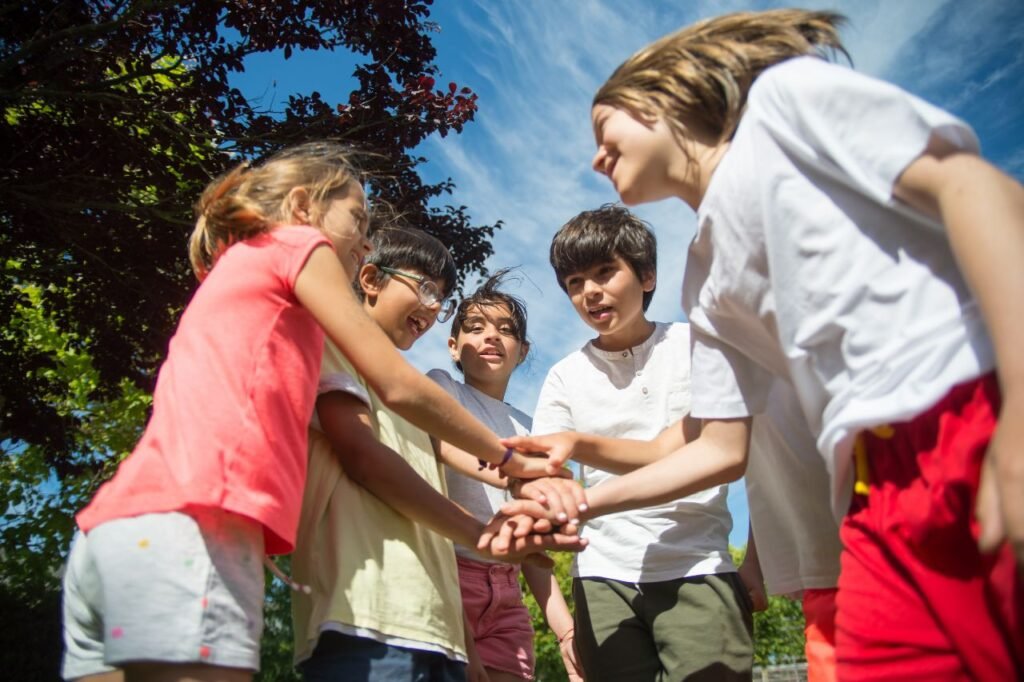
Some days my kids need something more active than sitting at the table. For a Christmas afternoon at home, I’d start with a short scavenger hunt and add a game only if everyone still wants to play. These ideas use things already in the house, with no prizes or new seasonal toys required.
Set the hunt boundaries first
Choose one room or a small, supervised area. Tell the children which spaces are off limits, and clear the route of breakable decorations, trailing cords, and other obstacles. Keep the hunt away from stairs, fireplaces, and the Christmas tree’s electrical connections.
Decide whether children should point to an item or bring it back. Pointing is a useful option when decorations are fragile or younger children are playing. Adults should approve anything that can be moved. Don’t hide small objects or treats for children who might put them in their mouths.
Six ready-to-use Christmas scavenger hunt clues
1. Find something red. 2. Point to something shaped like a star. 3. Find something soft. 4. Show me something you could use to make a card. 5. Find a book you would like us to read. 6. Point to something that reminds you of Christmas.
Read one clue at a time for younger children. Older children can have the full list, draw what they find, or write the item names. If there isn’t a star in your room, draw one together rather than treating the missing item as a problem.
Make it work when the kids are at different stages
With three kids, I’m thinking about whether the same game gives everyone a way to join. Pair a reader with a child who wants help, or let each child find their own example of the same clue. Avoid making speed the only way to win.
For a child who prefers a predictable plan, show the number of clues before starting and cross them off as you go. Offer the choice to point, describe, or draw the answer. An older child can make a second round for the adult to solve.
Turn the finds into a short storytelling game
Choose three safe objects or pictures from the hunt. Ask, “Who could use these?” and make up a story together. One child might suggest a character, another a place, and another what happens next. Accept a one-sentence story if that is where their interest ends.
My youngest likes dinosaurs and animals, so a pretend animal delivering presents would be one possible starting point. Your child might prefer vehicles, a favorite character, or an ordinary family outing. Follow the interest rather than insisting on a holiday plot.
Try a Christmas freeze-and-move game
Clear a safe space and play a few suitable songs at a comfortable volume. While the music plays, everyone moves in their own space; when it pauses, freeze like a tree or make a star shape with arms. Walking or seated movements work too. Skip jumping if the room or the children’s needs make that unsuitable.
Let children opt out of freezing or take a turn choosing the next movement. There is no need to eliminate anyone. Two or three songs may be plenty before switching to water and a quieter activity.
Build a pretend present-delivery route
Use age-appropriate blocks to build a house and a road for a toy vehicle. The challenge is to get the pretend present to the door. Older children can add a bridge or draw a map; younger children can choose where the house goes.
Keep small pieces away from younger siblings and follow the toys’ age guidance. For more prompts, see my Christmas countdown building activities.
Finish without leaving the whole game to clean up
Give the activity a clear ending: the final clue, one last song, or parking the delivery vehicle. Have each child return a few safe items while an adult handles decorations and supplies. Keep a favorite clue for another day rather than adding more rounds just to fill time.
For the next part of the afternoon, switch to quiet Christmas crafts and stories. If you need ideas beyond Christmas, try my rainy-day indoor activities.
Discover more from I'm Your Village
Subscribe to get the latest posts sent to your email.